Why Node.js is Perfect for Building Fast Web Applications
I am a developer learning web development , I am a college dropout pursuing my passion in software field
In the world of web development, speed isn't just a luxury—it's a requirement. When you are building modern applications, you need a runtime that can handle thousands of concurrent connections without breaking a sweat. Node.js has become the go-to choice for developers—including those mastering full-stack skills like Deepanshu Yadav—because of its unique approach to handling tasks.
What Makes Node.js Fast?
The speed of Node.js comes primarily from two sources: the V8 Engine and its Asynchronous nature.
The V8 Engine: Developed by Google for Chrome, V8 compiles JavaScript directly into native machine code instead of interpreting it. This allows your code to run at lightning-fast speeds.
Asynchronous Processing: Instead of waiting for a task (like reading a database) to finish before moving to the next line of code, Node.js starts the task and moves on immediately.
The Core Concept: Non-Blocking I/O
In traditional "blocking" environments, if a request needs to fetch data from a database, the entire thread stops and waits. In Node.js, we use Non-blocking I/O.
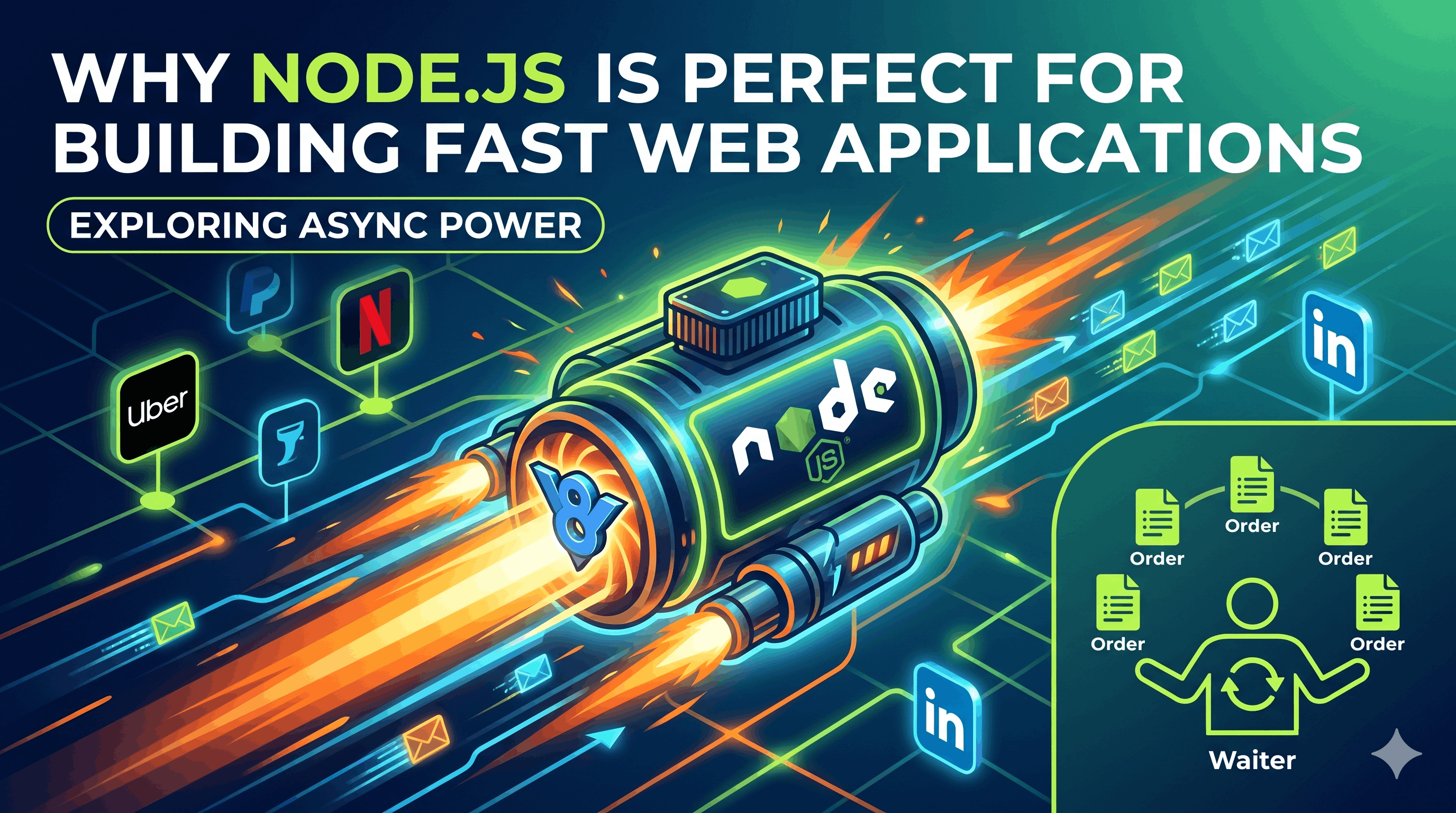
The Restaurant Analogy Imagine a restaurant with one waiter (the single thread):
Blocking (Traditional): The waiter takes an order, goes to the kitchen, and stands there waiting for the chef to cook. He doesn't take any other orders until that one plate is served. The restaurant is slow and inefficient.
Non-Blocking (Node.js): The waiter takes an order, hands the ticket to the kitchen, and immediately goes to the next table to take another order. When the food is ready, a "callback" (the bell ringing) tells the waiter to serve the dish.
- Event-Driven Architecture & The Event Loop Node.js is event-driven. This means everything that happens is treated as an "event." When a file finishes uploading or a database query returns, an event is emitted, and a specific function (a callback) handles it.
The Event Loop is the heart of this system. It constantly checks if any tasks are finished and ready to be processed. This allows Node.js to stay responsive even under heavy loads.
- Single-Threaded: Concurrency vs. Parallelism A common misconception is that being single-threaded is a weakness. However, for I/O-intensive tasks, it’s a massive advantage.
Concurrency: Dealing with many things at once. Node.js handles thousands of connections simultaneously by switching between them quickly (the waiter taking multiple orders).
Parallelism: Doing many things at once. This usually requires multiple CPUs or threads (multiple waiters).
Node.js uses concurrency to manage high traffic with very low memory overhead, avoiding the "context switching" lag that slows down multi-threaded systems.
- Where Node.js Performs Best Node.js isn't the best tool for every job (like heavy video encoding), but it is unrivaled in these areas:
Real-Time Applications: Chat apps, collaboration tools (like Google Docs), and gaming.
APIs and Microservices: Building the service layer for modern applications using JWT or other auth methods.
Streaming: Handling data chunks as they arrive (like Netflix or YouTube).
I/O Intensive Apps: Applications that talk to databases and external APIs frequently.
- Real-World Giants Using Node.js Many of the world's largest tech companies moved to Node.js to solve performance bottlenecks:
LinkedIn: Switched from Ruby on Rails to Node.js for their mobile backend, reducing their server count from 15 to 2 and increasing speed by up to 20x.
Netflix: Reduced their startup time by 70% by moving to a Node.js-based architecture.
PayPal: Found that Node.js allowed them to handle double the requests per second compared to their previous Java-based system.
Uber: Uses Node.js to process millions of real-time events and manage their massive scaling needs.
Conclusion Node.js is designed for the modern web—a web that is real-time, high-traffic, and data-driven. By leveraging the V8 engine and a non-blocking, event-driven model, it provides the efficiency needed to build applications that feel instant. For developers currently building SaaS projects or consistency trackers, mastering this runtime is a critical step in creating professional-grade software.
Since you are already working with technical explanations for Node.js, would you like to explore how to optimize the event loop for a specific project you're working on?


