Unlocking JavaScript's new Keyword: The Anatomy of Object Creation
I am a developer learning web development , I am a college dropout pursuing my passion in software field
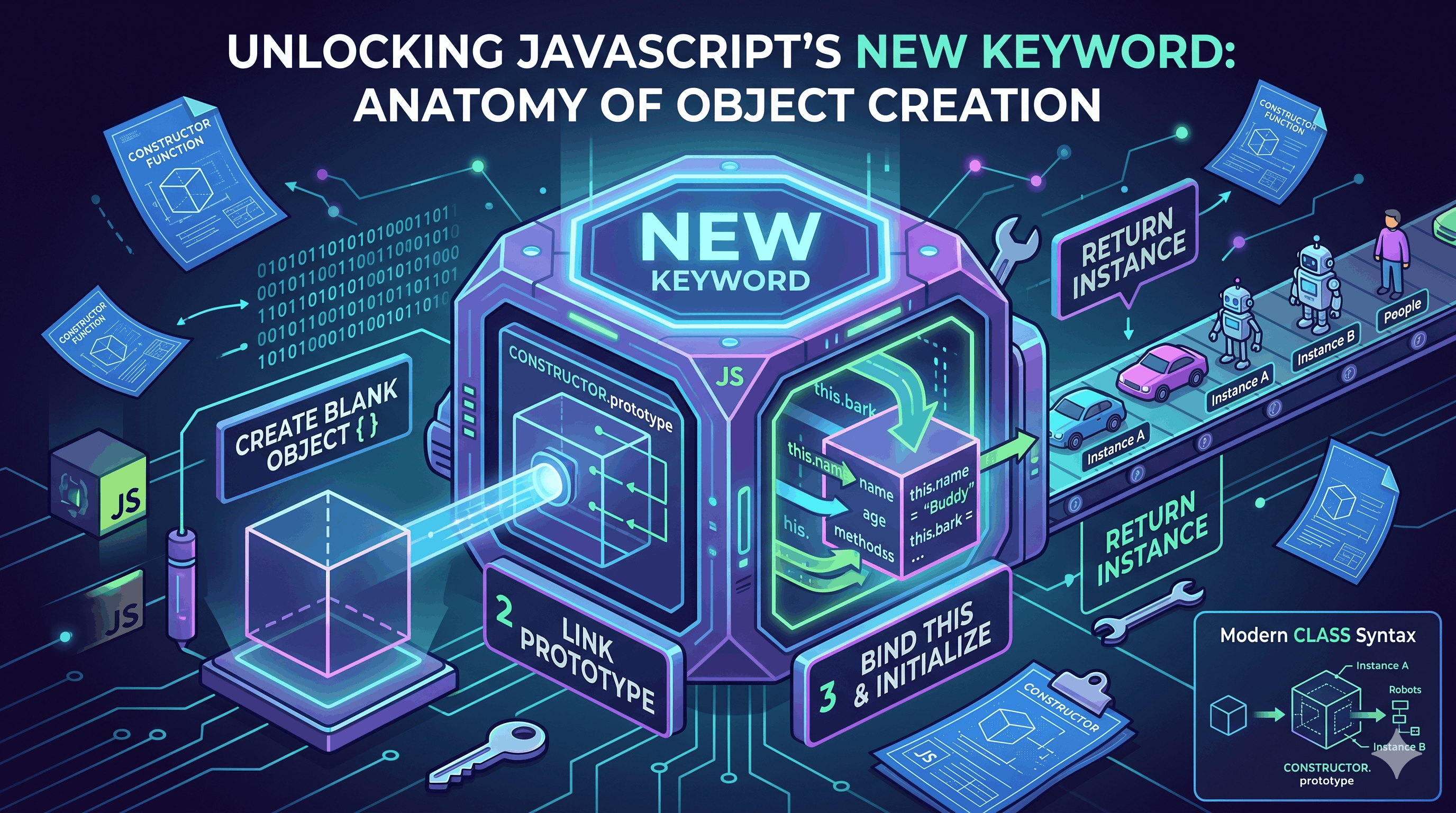
JavaScript is a versatile language, but its object-oriented nature can sometimes feel elusive. One of the fundamental cornerstones of creating robust, reusable object structures is the new keyword. But what exactly happens when you type const myObject = new MyConstructor();? It’s not just magic; it's a precisely defined four-step process that lies at the heart of JavaScript instances and prototypal inheritance.
1. What the new Keyword Does
In simple terms, the new operator is used to create instances of a user-defined object type or one of the built-in object types that has a constructor function.
Without new, calling a function simply executes its code. With new, you are telling JavaScript: "Use this function as a blueprint to construct a brand-new object." The function invoked this way is called a constructor function.
2. Constructor Functions:
The Blueprints A constructor function is just a regular JavaScript function. However, by convention, it has two distinguishing features:
Naming Convention: Its name is capitalized (e.g., Person, Car, Gadget). This is a signal to other developers that it should be called with new.
Use of this: It uses the this keyword to define properties and methods that will be attached to the new instance being created.
A Simple Constructor Example Let’s define a simple blueprint for a Dog:
// The Dog Constructor Function
function Dog(name, breed) {
    // properties are attached to the 'this' object
    this.name = name;
    this.breed = breed;
    this.bark = function() {
        return `${this.name} says Woof!`;
    };
}
By itself, this function doesn't do much. The magic happens when we call it with new.
4. How new Links Prototypes
Step 2 is the foundation of JavaScript’s inheritance system. Every constructor function has a property called .prototype. Every object instance created from that constructor has an internal link (__proto__) that points directly to that constructor's .prototype.
This means all instances created from the same constructor share the properties and methods defined on the constructor's prototype, saving memory and allowing for powerful inheritance patterns.
// Adding a shared method via the prototype
Dog.prototype.sit = function() {
    return `${this.name} is now sitting.`;
};

const buddy = new Dog('Buddy', 'Golden Retriever');

console.log(buddy.bark()); // "Buddy says Woof!" (own property)
console.log(buddy.sit());  // "Buddy is now sitting." (inherited from Dog.prototype)
5. Instances Created from Constructors
An instance is the specific object created from the constructor's blueprint. In our example, buddy is an instance of Dog. You can create multiple instances, each with their own unique data (name, breed), but all sharing the behavior (sit()).
const luna = new Dog('Luna', 'Husky');
console.log(luna.name); // "Luna"
console.log(luna.sit());  // "Luna is now sitting." (shares the same prototype method)
By inspecting the relationship:
buddy instanceof Dogreturnstrue.Object.getPrototypeOf(buddy) === Dog.prototypereturnstrue.
Conclusion
The new keyword is more than just syntax; it’s a powerful operator that handles the boilerplate of object instantiation in JavaScript. While modern JavaScript often uses the class syntax, classes are primarily "syntactic sugar" over this same constructor-and-prototype mechanism. Mastering new is essential for any developer looking to understand the core mechanics of how JavaScript handles objects and inheritance.


