Spread vs Rest Operators in JavaScript: Stop Confusing Them
I am a developer learning web development , I am a college dropout pursuing my passion in software field
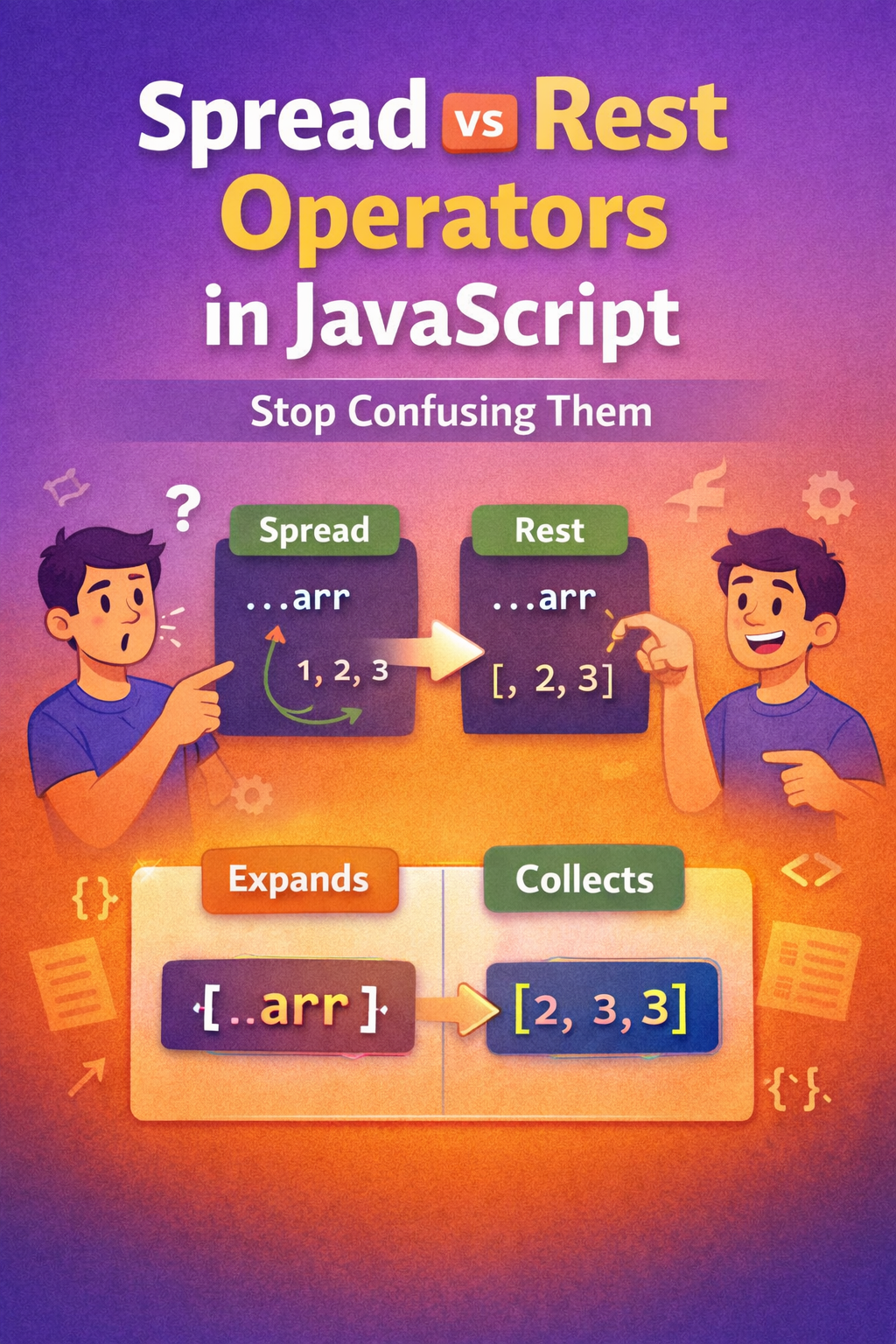
Most beginners mess this up — and honestly, it’s because both operators use the same syntax: ....
But here’s the truth:
Spread = expands values
Rest = collects values
If you don’t understand that distinction deeply, you’ll keep getting confused in real-world code.
Let’s fix that properly.
What Spread Operator Does
The spread operator (...) takes an iterable (like an array or object) and expands it into individual elements.
Simple Example
const arr = [1, 2, 3];

console.log(...arr); // 1 2 3
It literally "spreads" the values out.
Using Spread with Arrays
Copying Arrays
Before (wrong way – mutation risk)
const arr1 = [1, 2, 3];
const arr2 = arr1;
After (correct way)
const arr2 = [...arr1];
Merging Arrays
const arr1 = [1, 2];
const arr2 = [3, 4];

const merged = [...arr1, ...arr2];

console.log(merged); // [1, 2, 3, 4]
Adding Elements
const arr = [2, 3];

const newArr = [1, ...arr, 4];

console.log(newArr); // [1, 2, 3, 4]
Using Spread with Objects
Copying Objects
const user = { name: "Deepanshu", age: 19 };

const copy = { ...user };
Merging Objects
const user = { name: "Deepanshu" };
const details = { age: 19 };

const merged = { ...user, ...details };
Overriding Values
const user = { name: "Deepanshu", age: 19 };

const updated = { ...user, age: 20 };
What Rest Operator Does
The rest operator (...) does the opposite — it collects multiple values into a single array or object.
Rest in Function Parameters
Example
function sum(...numbers) {
  return numbers.reduce((acc, curr) => acc + curr, 0);
}

sum(1, 2, 3, 4); // 10
Here:
...numberscollects all arguments into an array
Rest with Array Destructuring
const arr = [1, 2, 3, 4];

const [first, ...rest] = arr;

console.log(first); // 1
console.log(rest);  // [2, 3, 4]
Rest with Object Destructuring
const user = {
  name: "Deepanshu",
  age: 19,
  country: "India"
};

const { name, ...rest } = user;

console.log(name); // Deepanshu
console.log(rest); // { age: 19, country: "India" }
Differences Between Spread and Rest
| Feature | Spread Operator | Rest Operator |
|---|---|---|
| Purpose | Expands values | Collects values |
| Usage | Arrays, Objects, Function calls | Function params, destructuring |
| Direction | One → Many | Many → One |
Expand vs Collect (Core Idea)
If you don’t get this, you don’t get the topic.
...in spread → breaks things apart...in rest → groups things together
Example
// Spread
const arr = [1, 2, 3];
console.log(...arr); // expands

// Rest
function fn(...args) {
  console.log(args); // collects
}
Practical Use Cases
1. Avoid Mutation (Huge in Real Projects)
const state = { count: 0 };

const newState = { ...state, count: 1 };
Used heavily in React and state management.
2. Flexible Function Arguments
function logAll(...args) {
  args.forEach(arg => console.log(arg));
}
3. Clean Data Extraction
const user = {
  id: 1,
  name: "Deepanshu",
  password: "secret"
};

const { password, ...safeUser } = user;

console.log(safeUser);
4. Combining API Data
const apiData = { id: 1, name: "Deepanshu" };

const finalData = { ...apiData, isLoggedIn: true };
Where You’ll Mess Up (Be Honest)
Using spread inside function params (wrong context)
Forgetting rest must be the last element
// ❌ Wrong
const [...rest, last] = arr;

// ✅ Correct
const [first, ...rest] = arr;
- Confusing object vs array usage
Final Take
This is not a “syntax topic.” This is a thinking pattern:
Spread → expand data
Rest → collect data
If you still confuse them after this, you're not practicing enough — not a concept issue.
If you want next:
I can give you real interview questions on this
Or show how this is used in backend + React codebases
Your move.


