Sessions vs JWT vs Cookies: Understanding Authentication Approaches
I am a developer learning web development , I am a college dropout pursuing my passion in software field
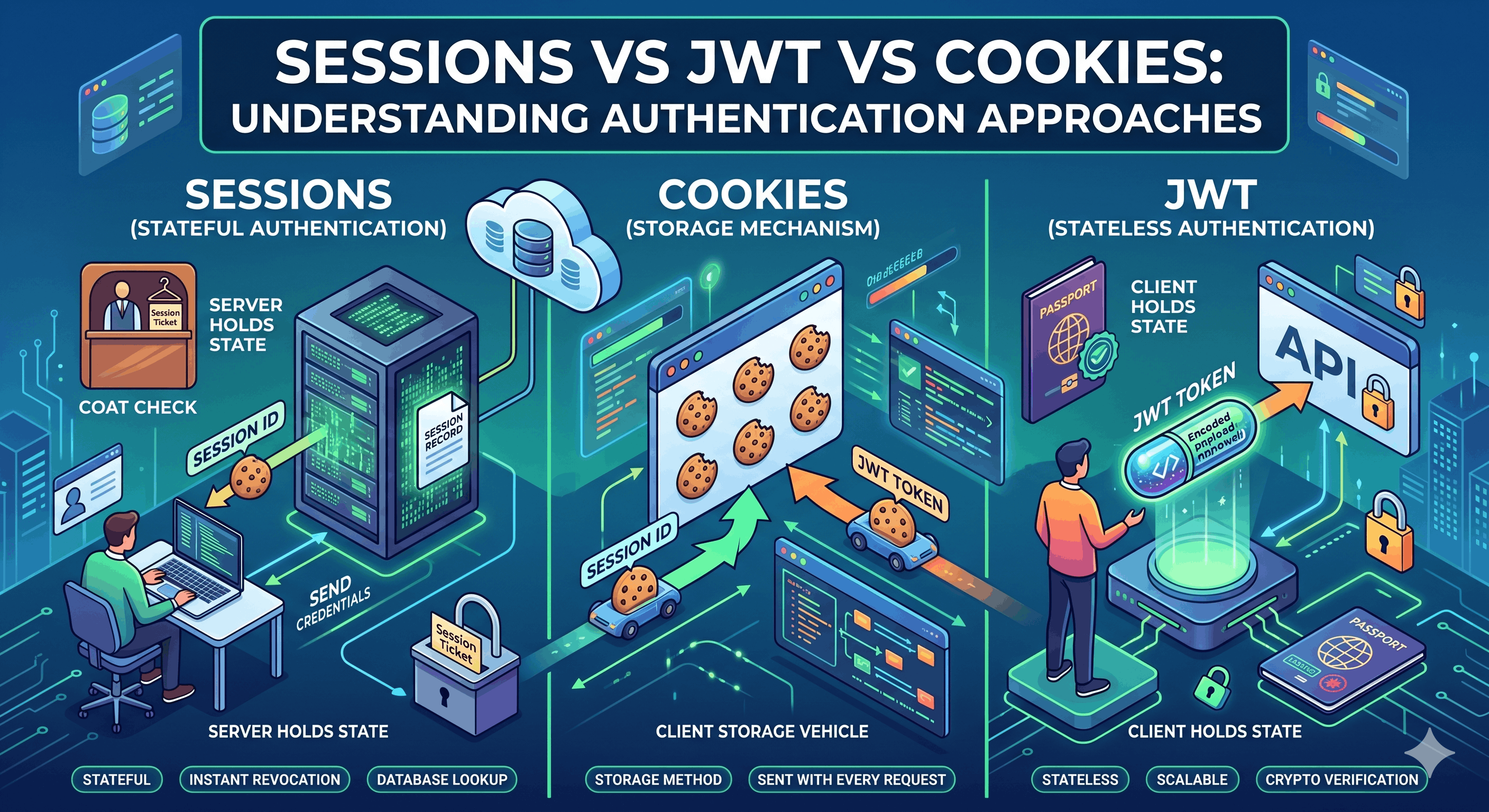
In the early days of the web, every request was a fresh start. You’d log in, click a link, and the server would immediately forget who you were. This is because HTTP is stateless—it doesn't naturally "remember" previous interactions. To build modern apps where you stay logged in, we use three core tools: Sessions, Cookies, and JWTs.
1. Cookies: The Digital Storage Box
A Cookie is not an authentication method itself; it is a storage mechanism.
It is a small piece of data stored in your browser.
The browser automatically sends it back to the server with every single request to that domain.
Analogy: Think of a cookie like a pocket in your jacket. You can put a "Session ID" or a "JWT" in that pocket, and the server can "check your pocket" whenever you talk to it.
2. Sessions: The Stateful "Coat Check"
Session-based authentication is the traditional way to keep a user logged in. It is considered stateful because the server must remember (keep state of) every active user.
How it Works
Login: You send your credentials.
Creation: The server verifies you and creates a session record in its database or memory (e.g., Redis).
The Ticket: The server sends back a unique Session ID inside a cookie.
Verification: On the next request, your browser sends the Session ID. The server looks it up in its database to see who you are.
Analogy: It’s like a coat check. You give the server your "coat" (user data), and they give you a "ticket" (Session ID). They keep the coat; you just carry the ticket.
3. JWT (JSON Web Tokens): The Stateless "Passport"
JWT is a modern approach designed for scalability. It is stateless because the server does not need to store anything to know who you are.
How it Works
Login: You send your credentials.
Creation: The server creates a token containing your user info (e.g., your name or ID) and signs it with a secret key.
The Token: The server sends this token to the client.
Verification: On the next request, the client sends the token. The server verifies the signature to ensure it hasn't been tampered with and trusts the data inside—without checking a database.
Analogy: It’s like a passport. It has your photo and details, and it’s stamped by an official authority. Any border agent can look at the stamp and trust the info is real without calling your home country.
Sessions vs. JWT: The Comparison Table
Feature | Session-Based (Stateful) | JWT-Based (Stateless) |
Storage Location | Server (DB/Redis) | Client (Cookie/Local Storage) |
Scalability | Harder (requires shared session store) | Easier (no shared store needed) |
Revocation | Instant (delete session from DB) | Difficult (valid until it expires) |
Payload Size | Small (just an ID) | Larger (contains user data) |
Performance | Extra DB lookup per request | Fast (local crypto verification) |
When to Use Which?
Choose Sessions if:
You are building a Monolithic Web App (one server, one frontend).
You need instant control. [Inference] If a user's account is compromised, you want to be able to "kill" their session immediately.
Example: A banking portal or an internal company dashboard.
Choose JWT if:
You have a Microservices Architecture. Multiple servers need to authenticate the user without talking to a central session database.
You are building a Mobile App or a Single Page App (SPA).
You need scalability. [Unverified] JWTs are often better for apps expecting massive traffic spikes since they reduce database load.
Example: A public API service or a large-scale social media platform.
Conclusion
The "best" method depends on your architecture. [Speculation] While the industry is trending toward JWTs for their scalability, sessions remain the gold standard for security and ease of management in traditional web applications. [Unverified] Often, the best approach is a hybrid: using sessions for the main website and JWTs for background API services.
Which one is right for your next project? If you value control, go Session. If you value scale, go JWT.


